

The License
This is the story of the scenario that scientists decided to retire, and the administration that celebrated its retirement.

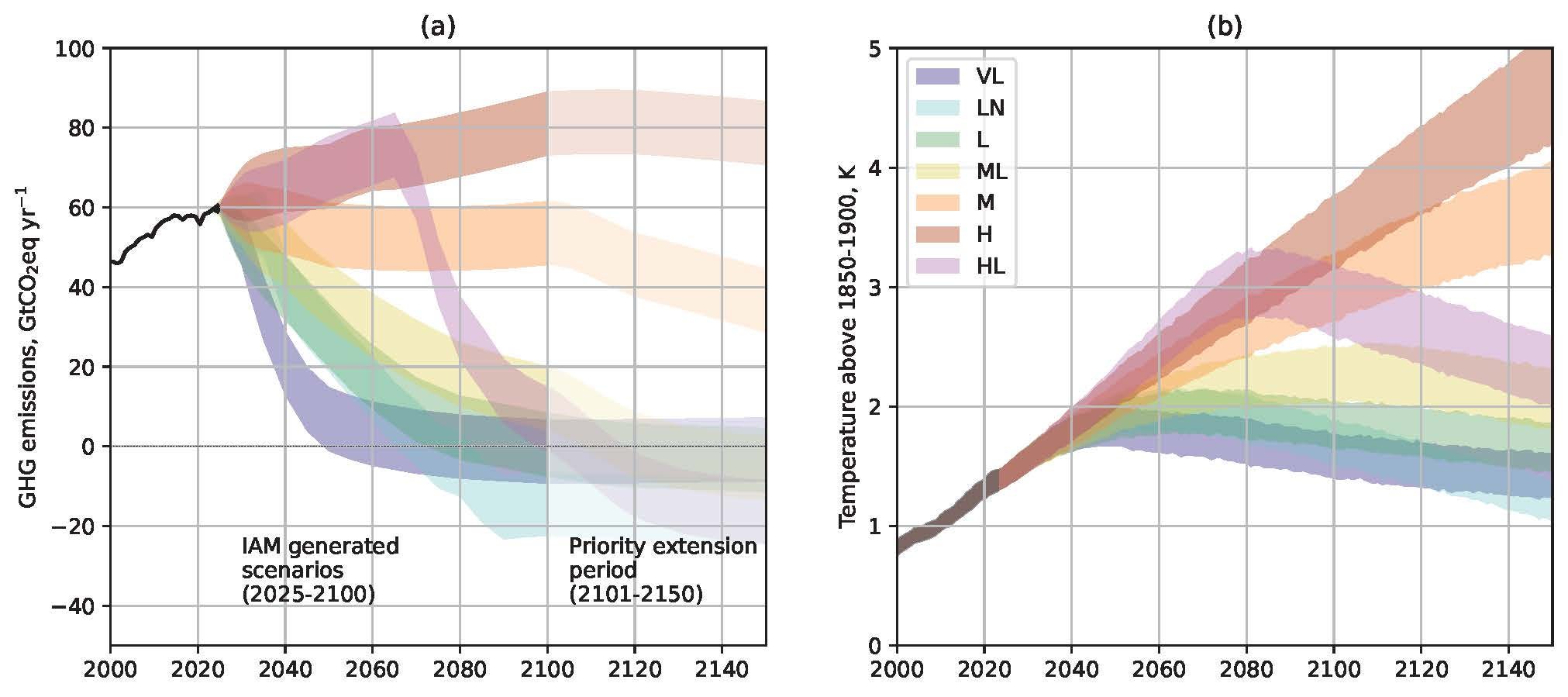
In June 2023, a committee of climate scientists met in Reading, in southern England, to review the scenarios that the next Intergovernmental Panel on Climate Change. (IPCC) report would use as a basis for projection. After three days of work, they decided to retire the scenario known as RCP 8.5, the worst case that had guided climate research since the early years of the previous decade. The scenario was a coherent prediction of the future. On paper, a catastrophe: a world with very high greenhouse gas emissions and no climate policies, where the concentration of CO₂ in the atmosphere would be more than double today’s (around 1,100 ppm against 425 ppm). But now, thanks to the advances of renewable energy, emissions regulation, and other environmental measures, that disaster no longer seems possible.
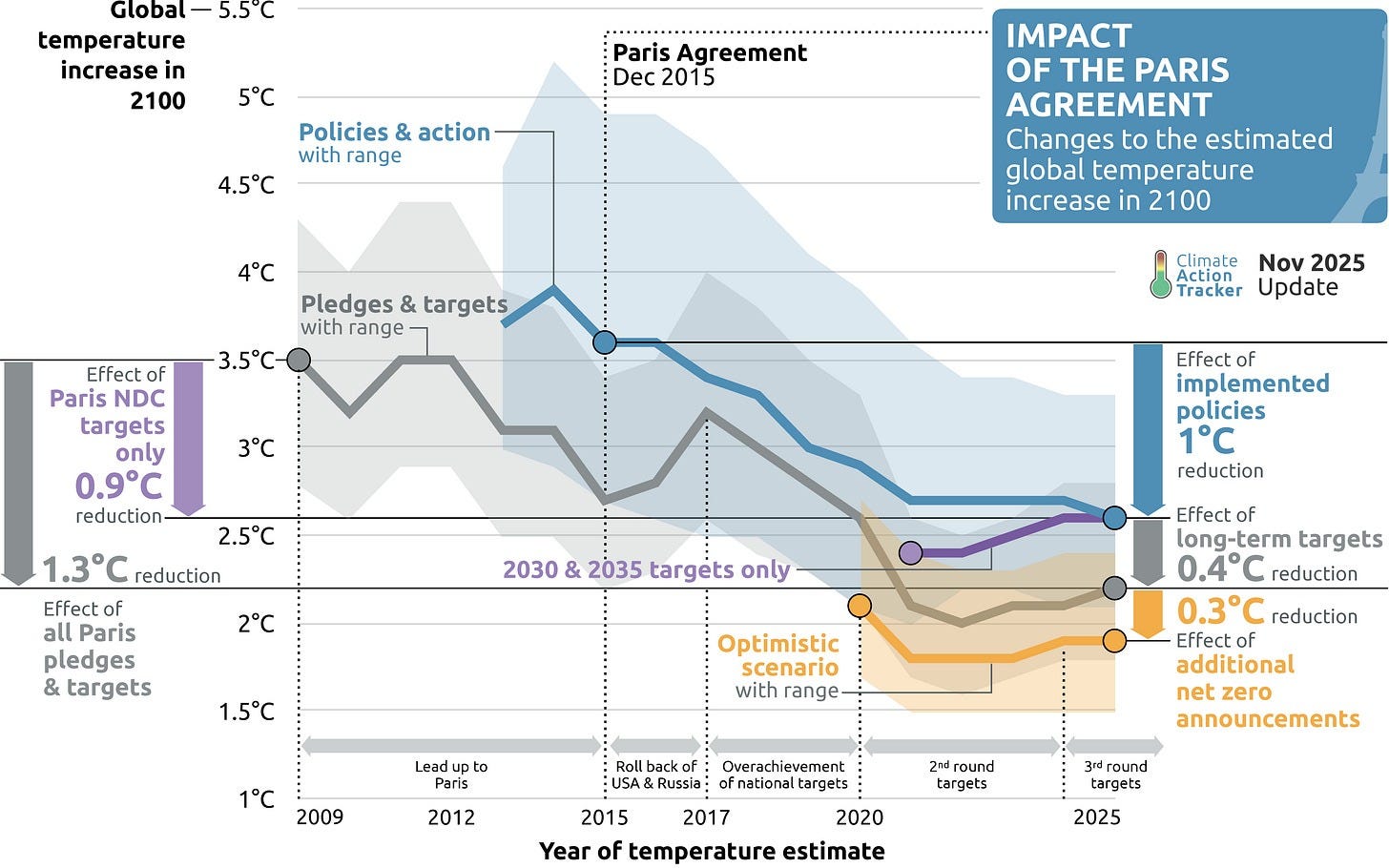
The correction was hard-won. Between 2009 and 2024, the price of solar electricity fell by 88%. In 2025, 86% of the world’s new electric capacity came from renewable sources. The article explaining the revision was published in Geoscientific Model Development in April 2026, the work of forty-four scientists from nineteen countries. In short, the worst possible scenario is now that the planet’s average temperature rises 3.5°C by 2100 (compared to the 1850–1900 level), rather than the 5°C the previous model projected.
The new high scenario still reaches 5°C, only fifty years later. It is a sincere technical correction. It is what science does when it works: it revises its conclusions when the evidence changes.
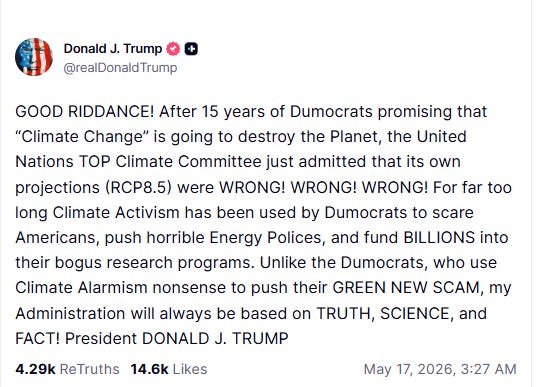
On May 17, the president posted on Truth Social: “GOOD RIDDANCE.” The administration, which shut down the main climate research lab in Colorado, blocked offshore wind projects, and kept unprofitable coal plants running, saw the scientific revision as a concession. They treated it as if the scientists who warned of disaster were admitting they were wrong. To them, it was a green light to keep heading toward disaster, believing that catastrophe is now off the table.
What changed was the paper, not the air.
The paper changed because the world was already changing. The projected curve shifted because coal was being replaced, solar power became cheaper than gas, and investment choices were moving in a new direction. The revision did not reveal a safer world; it simply recognized real changes that were already happening. Now, the so-called permit puts those changes at risk. If coal plants keep running, offshore wind is blocked, or solar subsidies are removed, the projections will go back to what they were before. This would not be because the models are flawed, but because the reality that justified the revision is being reversed on purpose.
This is not denialism. It is something more sophisticated. Denialism rejects the science; this system uses it.
It waits for the moment when an honest scientist corrects a projection, a careful biologist announces a breakthrough, or a committee revises a scenario, and turns each correction into a press release that says: See? It wasn’t so bad. In my previous essay, The Promise, I examined how Interior Secretary Doug Burgum invoked the possibility of de-extinction to propose a revision of the Endangered Species Act. The mechanism is the same. A scientific promise (the condor returns, the dire wolf and the moa can be resurrected through reengineering, the curve is deferred by fifty years) becomes a pretext for dismantling the hard-won protection against the original harm. The license to hunt with lead ammunition without thinking about the endangered bird, to drill in critical habitat, or to burn uneconomic coal is restored to the actors who had lost it.
It is not nostalgia, nor absence of conscience, but restoration.
There is a sentence Genevieve Guenther and Michael E. Mann wrote this May 22 in the Bulletin of the Atomic Scientists worth quoting in full:
“Future carbon emissions scenarios will be determined by politics. But the warming associated with those emissions is determined by physics.”
The line is exact up to a point. Politics can move the curve on paper. The air does not move by decree. But politics can move what physics will have to measure. Every uneconomic coal plant forced to remain open, every offshore platform left in service, every subsidy withdrawn from the transition, and every measure that strips away protections from the nature and the environment we live in, is a decision about what air will have to be measured (and breathed) in 2050.
The new model predicts a temperature rise of between 2.5°C and 4.3°C by 2100. This range is no longer just about uncertainty in the physics. Now, we also have to consider political uncertainty, which will decide how much climate progress might be lost in the next four years. Politics has become an internal variable of the model.
A variable the previous model did not have: how much of what was gained we will be able to preserve.