

307 Billion Years
An inventory of what we are losing, and the grammar of the loss

To Charles Brewer Carías
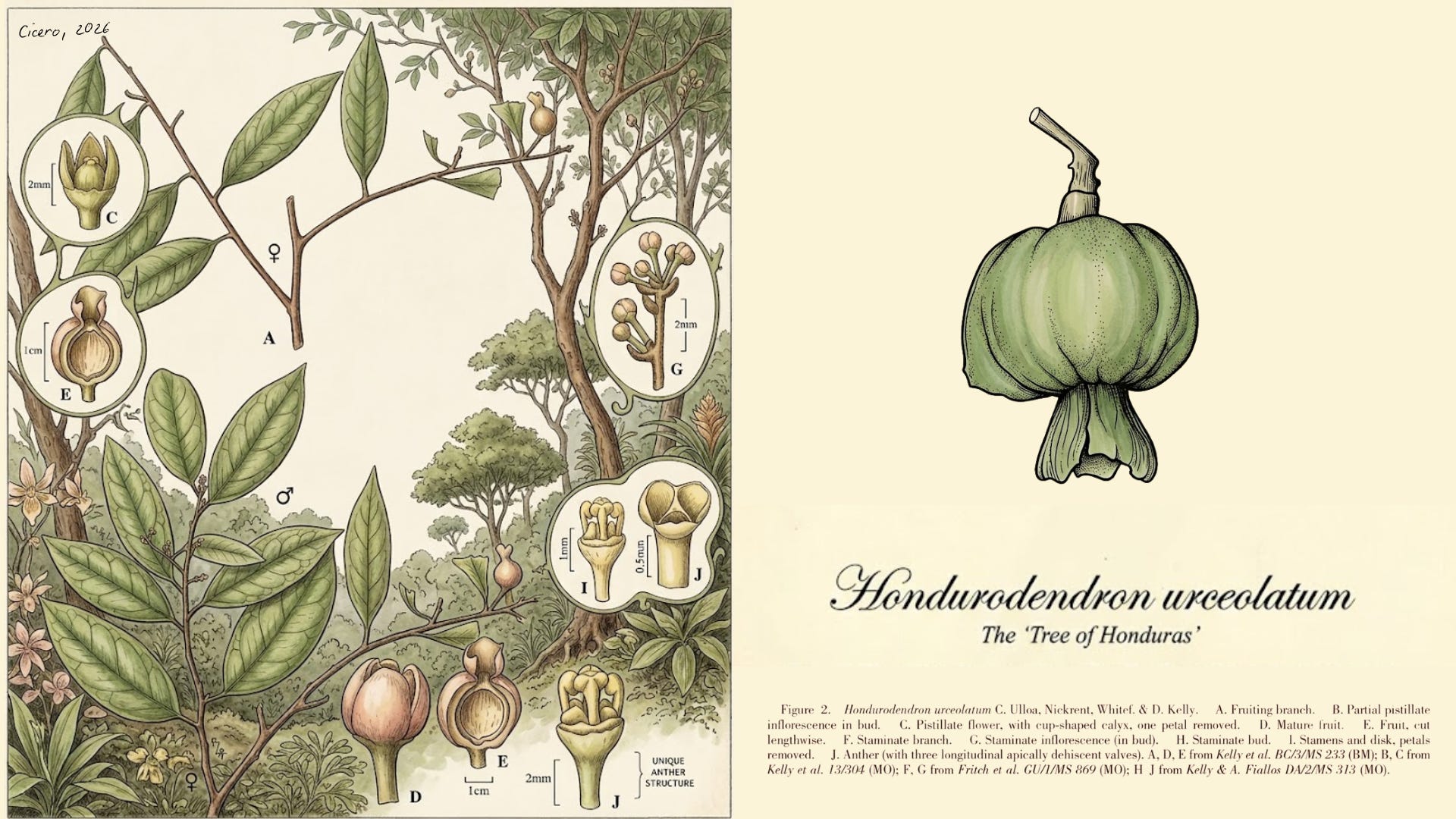
In the cloud forest of Parque Nacional El Cusuco, in the Sierra del Merendón of northwestern Honduras, there is a marvel that grows up to 40 feet tall, a tree relative to the sandalwood, whose bark has the aroma of roses and the locals call guayabillo. In 2010, it was scientifically cataloged as Hondurodendron urceolatum, the tree of Honduras. Scattered populations cling to a single mountain range. The tree is dioecious — male and female flowers on separate individuals — which means that for the species to continue, two of them have to find each other in a forest that is shrinking around them. As of last week, Hondurodendron sits at the top of the angiosperm EDGE list published in Science: the most evolutionarily distinct, globally endangered flowering plant on Earth.
The list is the work of Félix Forest and a team at Kew Gardens. It catalogs 9,945 species. To be on it, a plant has to carry a disproportionate share of the tree of life on its single trunk: to be the last representative, or one of a few, of a lineage that branched off long enough ago to have become irreplaceable. The list is not a memorial. It is closer to a ship’s manifest.
I find the number that comes with the list harder to hold. Forest’s team estimates that 21.2% of the evolutionary history embodied in the world’s flowering plants is currently at risk of extinction. That history, summed across every branch of the angiosperm tree, totals 1.45 trillion years. The threatened portion comes to 307 billion years. I cannot even imagine that number. How can anyone hold such a disproportion?
A human life accumulates about thirty thousand days. To lose three of them — the moment you met that friend, an afternoon with a lover that should have been recoverable, the day your child first said your name — is an accident, the ordinary erosion of being alive. Dementia is something else. Dementia is the sentence to permanent darkness: not the loss of a memory but the loss of the one who could have remembered. The archive and the archivist erased together. My friend, the explorer Charles Brewer Carías1 took me deep into the Amazonian jungle, and was able to name every plant and animal we passed on our expeditions. When he is gone, most of those names will go with him. Extinction is dementia at the scale of the planet. The mountain in Honduras is still there. What is leaving is the only thing that knew how to be Hondurodendron, and with it, the four billion years of trial that learned how to be Hondurodendron, a guayabillo, and nothing else.
Rachel Carson saw this ledger sixty-four years ago, in Silent Spring. The book did its work: DDT was banned, regulations were written, a movement was born. And then we kept spending. The ledger has not closed. It has only grown more detailed.

Here is the part that surprised me. A second paper in the same issue of Science, by Junna Wang and colleagues at UC Davis, modeled the future ranges of 67,664 plant species under climate change. They expected to find that extinction would be driven by “dispersal limitation.” Something equivalent to a border wall or a travel ban, but for plants unable to migrate fast enough from hostile land to track suitable habitat. That has been the assumption for decades. It turns out to be wrong. Between 70 and 80% of projected extinctions are caused not by plants moving too slowly, but by the suitable habitat itself disappearing. The places aren’t moving away from the plants. The places are vanishing. Like a migrant arriving at the promised land to find the promise rescinded, the sanctuary gone.
This is a different shape of loss than the one we had been imagining. The plants are not failing a footrace: The track is being demolished beneath them.
The right instinct is to protect the planet’s commons. But what works? In the Grand Bassin in Mauritius, a crater lake whose sacralization began in the nineteenth century with a Hindu priest’s dream, was deepened in 1972 when politicians poured a bottle of Ganges water into it, and is now guarded by a hundred-foot statue of Shiva. The fish population has remained intact while the rest of the island’s fisheries collapsed. The anthropologist Dimitris Xygalatas also writes about the Balinese subak, the temple-coordinated irrigation system that sustained rice cultivation for a thousand years until a modernization program nearly destroyed it in two decades, and was reinstated. The pattern holds across cultures. The commons humans have successfully protected are the ones they have treated as sacred. Everything else has been cataloged.
I am not arguing that we should sacralize the cloud forest of El Cusuco. Neither life nor the divine work that way. You cannot decide to find something sacred. The word names a relation, not a policy. What I am noticing is closer to a diagnosis: the technical vocabulary of conservation (evolutionarily distinct, globally endangered, phylogenetic diversity at risk) is the vocabulary of a culture that has already decided what it will lose. The list is not the rescue, it’s the receipt.
There is a particular silence in the Forest paper that I keep returning to. Among the 9,945 species, 4,076 are candidate EDGE species. These are plants whose extinction risk has not yet been formally assessed, but are predictably threatened. They are on the list because their close relatives are dying, and because the algorithm assumes (correctly, as far as anyone can tell) that we are losing them too, before we have measured what we have. The catalog is incomplete in the direction of greater loss.
A receipt records what was paid. Whether the payment was a purchase or a theft is a distinction made by the readers, and only while the ledger is still open.
Hondurodendron was named sixteen years ago by Daniel Nickrent and his colleagues. In all likelihood, he will be a witness to how the genus he discovered has gone extinct. The mountain where the guayabillo grows has not moved. What is leaving is the forest that turns the mountain into a place where this tree can thrive, and the tree that knew, across four billion years of patient trial, how to be alive there.
The list is a record. And a record, without someone to read it, is only a darker form of forgetting.
Charles is an athlete of 87, a renowned explorer and naturalist, considered by some the Humboldt of the twentieth century (let’s add to it the 21st). He took me on a scientific expedition that led to one of his greatest discoveries, the largest quartzite cave in the world, a giant hidden on top of the Chimantá Tepuy. Dozens of species of plants and animals have been named after him.